
Tutti

Overview
Tutti is a musical instrument system made up of a central hub and three modules: Tono, Melo, and Tempo. Designed to introduce children to music-making through play-based exploration.
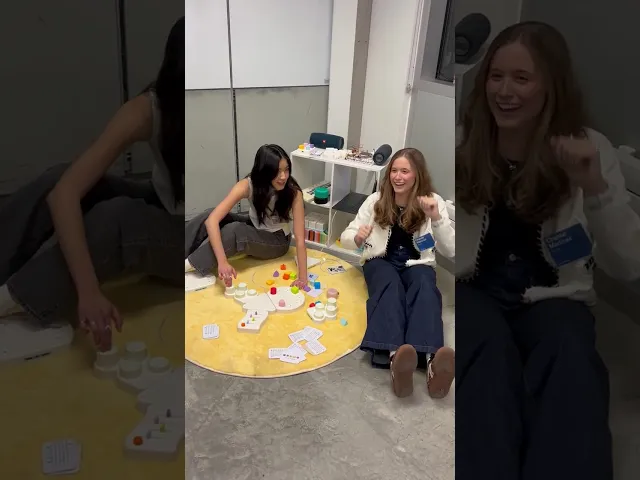
Tutti: with all instruments performing together
Collaborator: Chantal Martinez
Technologies:
Sound Design: Tone.js
Hardware: Sensors (Force, Photoresistor, Rotary Potentiometer, Slide Potentiometer), ESP32 Feather V2, Multiplexers, Magnetic Pin Connectors, 3D Printing
Role: Hardware Engineer & Sound Designer
– Patent Pending –
Traditional musical instruments often require prior knowledge of notation, technique, and structured instruction. For young beginners, these initial learning barriers can make music-making feel more like a task to master than an opportunity to explore.
Tutti explores how physical interaction, visual cues, and playful experimentation can create a more intuitive entry point into music. Instead of focusing on teaching musical correctness, the goal was to encourage curiosity, experimentation, and the desire to make music together.
How might collaborative, tactile play serve as an entry point to musical curiosity for children and beginning learners?
To understand different experiences with music learning, we spoke with elementary educators, music teachers, and musicians about how they first learned to play and what kept them engaged with music. Their experiences ranged from private lessons and school bands to online resources and self-directed learning. A recurring theme was the importance of playing with others. Several shared that after leaving school or other structured musical environments, they gradually lost opportunities to make music collaboratively, and with them, some of the enjoyment that came from playing together.
These conversations helped shape our interest in creating a more playful approach to music-making, with collaboration becoming an important part of the design direction (more on this later).
Colour-shape-sound relationship
Early prototyping focused on understanding how different physical interactions could be translated into sound. Through a series of low-fidelity studies and functional prototypes, we explored how gestures such as shape placing, sliding, and tapping could introduce different aspects of music-making.
Early studies using paper, explored how colour and shape could represent individual notes. Different shapes were arranged and rearranged to investigate how users interpreted visual patterns and relationships without musical instruction.
These explorations progressed into photocell-based prototypes, where placing physical blocks over sensors triggered corresponding notes through Tone.js. This introduced real-time audio feedback and established a relationship between physical placement and sound.


Melody-making through sliding
Inspired by DJ mixers and the sliding movement of instruments such as the trombone, slide potentiometers were explored as a way to control pitch. Four sliders were arranged side by side to create looping melodic patterns, with a rotary control adjusting playback speed.
The pitch range was kept relatively simple, using a subset of the C major scale (C4, E4, F4, G4, A4, C5), along with an off state. This gave children room to experiment with different melodic patterns while keeping the notes generally harmonious.


Beat-making through tapping
Force sensors introduced tapping as another form of interaction. Each sensor triggered a distinct percussive sound, corresponding to a kick, hi-hat, tom, or snare. In Tone.js, I experimented altering various parameters such as pitch, decay, sustain, etc. to give each pad its own sound, allowing users to create rhythmic patterns through physical impact.
These prototypes each presented a unique interaction paired with a distinct sound. While these early instruments successfully explored different aspects of music, such as rhythm, pitch, and melody-making, they remained an independent instrument. This limitation prompted a shift toward collective music-making through the development of an integrated instrument system, one that allows children to explore each musical concept independently and then discover how they connect when played together.

The three instruments were brought together around a central triangular hub, which housed the microcontroller and served as the core of the system. Each instrument was envisioned to connect directly to this hub, creating a shared connection for interaction and sound-making. Multiples of the same instrument can also attach to the hub simultaneously (eg. two tono modules and one tempo).

Tono explores harmony through color- and shape-coded blocks, each corresponding to a note in the C major scale. Placing blocks into eight positions around the module allows users to build harmonies and explore relationships between notes through spatial arrangement.
Melo is a looping sequencer with four vertical sliders for controlling pitch and a rotary knob for adjusting playback speed. The available notes are limited to an adapted C major scale (C4, E4, F4, G4, A4, C5), with an off state, allowing users to experiment with melodic patterns.
Tempo introduces rhythm through four spring-loaded circular pads corresponding to kick, snare, hi-hat, and tom sounds. Each pad responds to pressure, letting users create beats through familiar tapping gestures.
Visual notation system


To help children connect the sounds they create with a visual representation of music, my collaborator, Chantal, developed a set of characters corresponding to each of Tono’s coloured blocks. Each character represents a different note, creating a playful visual language that connects colour, shape, and sound. Additionally, she also designed song cards featuring familiar nursery rhymes. Each card uses the characters to show which notes make up the song, along with visual cues for note duration and repetition. This gives children a way to follow and recreate simple melodies without needing to read traditional sheet music.

Observations:
Intuitive interaction: Children began experimenting with the instruments without needing detailed instructions.
Visual associations: Colour and shape helped children recognize and explore relationships between notes.
Collaborative play: Distinct instrument roles encouraged children to listen, coordinate, and build music together.

Physical sensing & input expansion
Tutti uses 17 sensor inputs across its three modules: four force sensors in Tempo, eight photocells in Tono, and five potentiometers in Melo. To support multiple instances of the same instrument connected simultaneously, the system needed to accommodate up to 27 analog inputs, exceeding the available pins on most compact microcontrollers.
To address this, I implemented two 16-channel analog multiplexers, expanding the number of sensor inputs the Adafruit ESP32 Feather V2 could read.
Module detection & connectivity
Each instrument connects to the central hub through two 5-pin and one 3-pin magnetic connectors. I implemented a pull-up resistor voltage divider system to identify connected modules and prevent disconnected sensor inputs from generating unintended sounds. The hub uses a fixed 100 kΩ pull-up resistor, while each instrument contains a unique resistor value that produces a distinct analog reading when connected. This allows the microcontroller to identify both the presence and type of each module, and disregard sensor inputs from empty connections rather than interpreting floating readings as user interaction.
This system allows Tutti to operate with just one or two instruments connected, while also supporting multiple instances of the same module.
Sound Generation & Processing
The multiplexers collect sensor readings and transmit them to the computer as a continuous serial data stream. In p5.js, I parse the incoming data and route each sensor value to its corresponding instrument logic.
Using p5.js and Tone.js, I mapped sensor inputs to sound parameters and developed distinct sound behaviors for each instrument. Pressure triggers percussion in Tempo, slider positions control pitch and looping sequences in Melo, and photocells trigger notes in Tono. Synthesis parameters such as pitch, volume, decay, and timing were adjusted to give each instrument its own sonic character.

Note: not the best video but a short demo of Chantal & I playing Tutti! email me if you would like more info. thank you :-)